Managing Ulcerative Colitis: Symptoms, Treatment, and Lifestyle Tips for Long-Term Relief
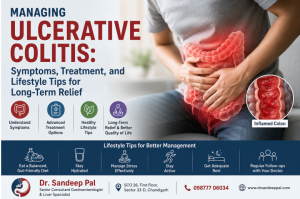
How can patients in Chandigarh achieve long-term remission and symptom control for Ulcerative Colitis?
Answer: Patients can achieve long-term remission from Ulcerative Colitis by combining precise, individual-focused medical therapies — such as anti-inflammatory agents and advanced biologics — with tailored dietary adjustments, stress management techniques, and continuous clinical oversight from an experienced gastroenterologist in Chandigarh. Early diagnosis and proactive management are key to stopping chronic flare-ups and restoring quality of life.
Ulcerative Colitis (UC) is an Inflammatory Bowel Disease (IBD) that causes chronic inflammation and ulcers along the innermost lining of the large intestine (colon) and rectum. For many individuals, living with UC feels unpredictable. One week you might feel completely fine, and the next you might experience frequent trips to the bathroom, severe abdominal cramping, and persistent fatigue.
If you or a family member are navigating an Ulcerative Colitis diagnosis, it is essential to know that long-term control and an active, fulfilling life are fully achievable.
What Is Ulcerative Colitis and How Does It Affect Your Gut?
Unlike conditions that affect any part of the digestive tract, Ulcerative Colitis is strictly localized to the colon and rectum. The disease typically begins in the rectum and can spread upward to involve parts of the colon or the entire organ.
When the immune system mistakenly targets the tissue in your large intestine, it triggers ongoing inflammation. Over time, this inflammation leads to tiny open sores (ulcers) that produce mucus and pus, causing the classic symptoms associated with IBD.
Common Symptoms to Watch For:
- Frequent, Urgent Bowel Movements: Often accompanied by an inability to delay defecation (tenesmus).
- Bloody Stools or Mucus: Seeing bright red or dark blood during bowel movements.
- Abdominal Cramping and Pain: Pain that often subsides temporarily after a bowel movement.
- Chronic Fatigue and Low Energy: Caused by poor nutrient absorption, systemic inflammation, or mild anemia.
- Unintended Weight Loss: Occurring due to reduced appetite and rapid nutrient transit through the gut.
Diagnosing Ulcerative Colitis: Why Early Clinical Evaluation Matters
A clear and timely diagnosis is the critical first step toward preventing long-term complications such as colon wall thickening or severe anemia.
From our Clinic Perspective, treating Ulcerative Colitis requires looking beyond symptom suppression. Accurate diagnosis relies on combining clinical history, targeted laboratory tests (such as stool inflammatory markers like fecal calprotectin), and visual evaluation of the mucosal lining. By carefully evaluating the exact extent and severity of inflammation early on, your treatment plan can be tailored specifically to your body’s needs.
Medical Treatment Options: Achieving and Maintaining Remission
The main goal of Ulcerative Colitis treatment is twofold: inducing remission (stopping active flare-ups) and maintaining remission (preventing future symptoms). Treatment plans generally vary depending on whether the disease is mild, moderate, or severe.
[ Active UC Flare-Up ]
│
▼
┌───────────────────────────────┐
│ Induction Phase Therapy │
│ 5-ASAs / Targeted Medication │
└───────────────┬───────────────┘
│
▼
┌───────────────────────────────┐
│ Symptom Control Achieved │
└───────────────┬───────────────┘
│
▼
┌───────────────────────────────┐
│ Maintenance Phase Therapy │
│ Long-Term Disease Control │
└───────────────┬───────────────┘
1. Anti-Inflammatory Medications (5-ASAs)
For mild to moderate Ulcerative Colitis, 5-aminosalicylates (such as mesalamine) serve as the primary foundational therapy. These medications work directly on the lining of the colon to reduce local swelling and promote tissue healing.
2. Immunomodulators & Biologic Therapies
In cases where symptoms are more stubborn or severe, advanced therapies like immunomodulators or targeted biologics are utilized. These treatments work by modulating specific pathways in the immune system to interrupt the inflammatory cycle safely under specialist supervision.
3. Targeted Symptom Control
During an acute flare-up, short-term targeted medications may be used to bring immediate relief while longer-term maintenance therapies build up efficacy in your system.
Essential Lifestyle & Dietary Tips for UC Management
While medical treatment provides the foundation for mucosal healing, daily habits play an indispensable supporting role in maintaining gut health and managing flare-ups.
Dietary Adjustments
- Keep a Daily Food & Symptom Diary: Track how your stomach reacts to different foods to identify personal triggers without unnecessarily eliminating nutritious food groups.
- Modify Fiber Intake During Flares: While high-fiber foods are generally healthy, switching to low-residue, easily digestible meals (cooked vegetables, lean proteins, plain rice) during an active flare can give your bowel a resting period.
- Stay Hydrated: Frequent loose stools can quickly lead to dehydration. Ensure you drink plenty of fluids and electrolyte-rich beverages daily.
Stress Reduction Practices
The gut and the brain communicate constantly via the gut-brain axis. Psychological stress does not cause Ulcerative Colitis, but it is a well-documented trigger for physical flare-ups.
- Practice regular gentle physical activity, such as walking or light yoga.
- Prioritize 7–8 hours of restful sleep every night.
- Incorporate simple breathing exercises or mindfulness techniques into your morning or evening routine.
Frequently Asked Questions (20 Detailed Clinical FAQs)
Section A: 10 Comprehensive, Detailed FAQs
Q1: What is the primary difference between Ulcerative Colitis and Crohn’s Disease?
Answer: While both Ulcerative Colitis (UC) and Crohn’s Disease belong to the Inflammatory Bowel Disease (IBD) family, they differ significantly in location and depth of tissue involvement. Ulcerative Colitis strictly affects the innermost lining (mucosa) of the large intestine (colon) and rectum in a continuous, unbroken pattern starting from the rectum upward. In contrast, Crohn’s Disease can affect any segment of the gastrointestinal tract from the mouth to the anus, often appearing in non-continuous “skip lesions” and penetrating through all deeper layers of the intestinal wall.
Q2: Can Ulcerative Colitis be permanently cured without surgery?
Answer: Currently, there is no permanent medical cure for Ulcerative Colitis, but long-term mucosal healing and deep clinical remission are fully achievable with modern medical treatments. Through structured protocols involving 5-ASAs, immunomodulators, or targeted biologics, patients can live completely symptom-free for years. The only definitive cure is surgical removal of the colon (colectomy), which is reserved for severe, treatment-resistant cases or emergency complications.
Q3: How do doctors determine whether a patient is in clinical remission?
Answer: Clinical remission is determined through a combination of subjective symptom relief and objective medical markers. A gastroenterologist evaluates the absence of rectal bleeding, normal bowel frequency, and relief from abdominal pain. Furthermore, objective confirmation is done using blood inflammatory markers (CRP), stool markers (fecal calprotectin), and mucosal inspection during follow-up procedures to verify that the tissue lining has physically healed.
Q4: Why is fecal calprotectin testing useful for Ulcerative Colitis management?
Answer: Fecal calprotectin is a reliable non-invasive stool biomarker that directly measures neutrophil-driven inflammation in the intestinal mucosa. Instead of relying solely on symptom reports — which can sometimes be misleading — testing calprotectin levels allows your gastroenterologist to detect impending flare-ups early, assess how well your current medication is working, and differentiate between active IBD inflammation and secondary conditions like Irritable Bowel Syndrome (IBS).
Q5: Are dietary changes alone sufficient to control active Ulcerative Colitis flares?
Answer: No, dietary modifications alone cannot control or suppress an active Ulcerative Colitis flare-up. UC is an autoimmune-mediated inflammatory disease of the intestinal tissue that requires targeted anti-inflammatory or biologic medications to heal mucosal damage. While diet plays a crucial supportive role in relieving mechanical discomfort, preventing nutritional deficiencies, and identifying personal symptom triggers, it must always be paired with prescribed medical therapy.
Q6: How does psychological stress trigger physical flare-ups in UC patients?
Answer: Stress activates the gut-brain axis, a bi-directional neural and hormonal communication pathway between the central nervous system and the gastrointestinal tract. Elevated stress hormones like cortisol and catecholamines can alter gut motility, increase intestinal mucosal permeability (“leaky gut”), disrupt the protective mucus barrier, and stimulate immune cells in the gut wall, directly promoting localized inflammation and triggering a physical relapse.
Q7: What long-term health risks are associated with unmanaged Ulcerative Colitis?
Answer: Leaving Ulcerative Colitis unmanaged or poorly controlled increases the risk of chronic gut structural damage, severe anemia from ongoing rectal blood loss, malnutrition, toxic megacolon (a life-threatening dilatation of the colon), and osteoporosis due to poor nutrient absorption. Additionally, long-standing continuous inflammation elevated over 8 to 10 years significantly increases the statistical risk of developing colorectal dysplasia and colon cancer, making routine clinical surveillance essential.
Q8: How do 5-ASA (Mesalamine) medications work inside the inflamed colon?
Answer: 5-Aminosalicylic acid (5-ASA) compounds work topically on the inflamed inner lining (mucosa) of the colon. Once released in the bowel, they inhibit cyclooxygenase and lipoxygenase pathways, preventing the synthesis of inflammatory prostaglandins and leukotrienes. By stopping these local chemical signals, 5-ASAs lower tissue swelling, promote mucosal re-epithelialization, and prevent new inflammatory damage from developing during maintenance therapy.
Q9: What should an Ulcerative Colitis patient eat during an active flare-up?
Answer: During an active flare-up, the goal is to provide adequate nutrition while minimizing mechanical work for the inflamed colon. Patients are advised to follow a temporary low-residue, low-fiber diet consisting of soft, easily digestible foods like plain white rice, well-cooked skinless applesauce, lean steamed proteins (chicken, fish), clear broths, and boiled tubers. Raw vegetables, nuts, seeds, spicy meals, caffeine, and heavy dairy products should be restricted until the mucosal surface cools down.
Q10: When should an IBD patient consider biologic therapies over conventional drugs?
Answer: Biologic therapies are considered when conventional first-line treatments (such as oral or topical 5-ASAs) fail to induce or maintain clinical remission, or when a patient experiences frequent flare-ups requiring repeated steroid courses. Biologics specifically target isolated immune proteins like TNF-alpha or specific integrins, stopping inflammatory cascades at their source before broad systemic side effects occur.
Section B: 10 Concise, Short FAQs
Q11: What is the main cause of Ulcerative Colitis?
Answer: It is caused by an abnormal immune reaction where the body’s immune system mistakenly attacks the lining of the large intestine, driven by genetics, gut microbiota, and environmental triggers.
Q12: Is Ulcerative Colitis hereditary?
Answer: Yes, having a first-degree relative (parent or sibling) with IBD increases your risk, though many patients have no family history of the condition.
Q13: Can alcohol or coffee cause an Ulcerative Colitis flare-up?
Answer: Yes, both alcohol and caffeine can irritate the intestinal mucosal lining, accelerate bowel motility, and worsen diarrhea during active flares.
Q14: Is blood in stool always present with Ulcerative Colitis?
Answer: Blood in the stool is a primary hallmark of UC, especially when inflammation involves the rectum, though mild or early cases may present primarily with loose stools and cramping.
Q15: How often should UC patients undergo surveillance colonoscopy?
Answer: Surveillance colonoscopies are generally recommended every 1 to 3 years starting 8 to 10 years after initial diagnosis to monitor colon health and rule out pre-cancerous tissue changes.
Q16: Can I take over-the-counter painkillers like Ibuprofen for UC cramps?
Answer: No, NSAIDs like ibuprofen, naproxen, and aspirin can irritate the stomach lining and actively trigger or worsen UC flare-ups. Paracetamol is generally preferred.
Q17: Does Ulcerative Colitis cause joint pain outside the gut?
Answer: Yes, up to 30% of IBD patients experience extra-intestinal manifestations, most commonly peripheral arthritis causing joint swelling in the knees, ankles, or wrists.
Q18: Are probiotics helpful for Ulcerative Colitis?
Answer: Certain clinically studied probiotic formulations can help maintain remission in mild UC cases, but they should only be added under a specialist’s guidance.
Q19: Can pregnant women continue taking Ulcerative Colitis medication?
Answer: Most foundational UC medications (like 5-ASAs and many biologics) are safe during pregnancy, and maintaining remission is crucial for a healthy pregnancy. Always consult your gastroenterologist.
Q20: What is tenesmus in Ulcerative Colitis?
Answer: Tenesmus is the persistent, painful, and urgent feeling of needing to pass stool, even when the rectum is completely empty, caused by localized rectal inflammation.
When Should You Seek Specialist Medical Care?
If you experience persistent changes in your bowel habits lasting more than a few days, notice blood in your stool, or suffer from recurrent abdominal cramps, consulting a qualified specialist is vital.
Patients in the Tricity area can receive personalized medical evaluations, diagnostic assessments, and long-term IBD management plans directly at our clinic in Sector 33D, Chandigarh. Early clinical intervention remains the most effective strategy to safeguard your digestive health and ensure peace of mind.
.jpg)

Comments
Post a Comment